How to Build a Paver Patio Step by Step
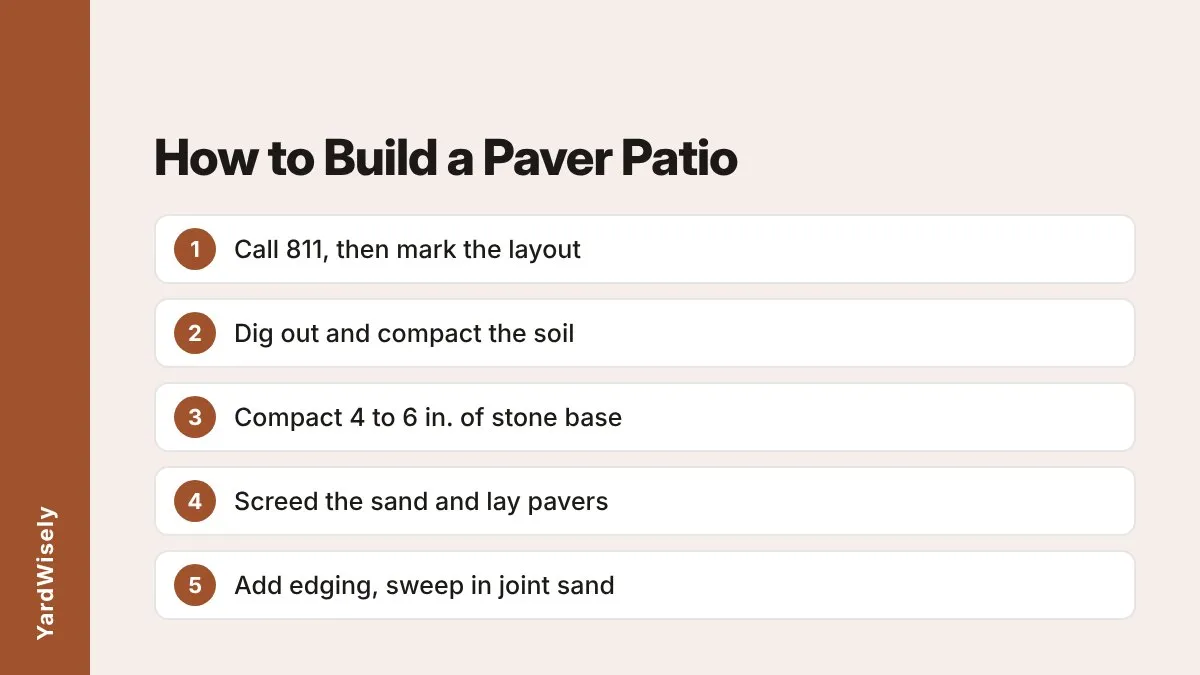
Build a paver patio in the right order: call 811, excavate, compact the gravel base, screed the sand bed, lay pavers, add edging and sweep in joint sand.
 Save
A paver patio is built in layers: compacted soil, a compacted crushed-stone base, a thin screeded sand bed, the pavers, then edging and joint sand. Skipping or rushing the base is what usually leads to sinking and shifting later. Work in this order and the patio stays flat for years.
Quick answer
- Call 811 first (in the UK or Australia, use your local utility locating service) so buried lines are marked before you dig.
- Dig deep enough for the base, the sand and the paver thickness together.
- Compact the base in thin layers, then screed 1 to 2 inches of sand.
- Lay pavers, fit edge restraints, sweep joint sand into the gaps and compact once more.
Before you dig
Check three things before breaking ground:
- Utilities. Call 811 before any excavation to have underground lines marked.
- Rules. Look up local building codes and any homeowners association (HOA) requirements. Some areas require a permit, so confirm before you buy materials.
- Drainage. Plan the surface to slope away from the house so water does not collect against the foundation.
What you need
- Pavers, plus a small extra allowance for cuts
- Crushed stone for the base (3/4 inch crushed stone with fines is one commonly recommended type)
- Coarse bedding sand (not play sand or fine sand)
- Edge restraints for the whole perimeter
- Geotextile fabric if you have clay, silt or a high water table
- Shovel, string line and stakes, tape measure, level
- Plate compactor (usually hireable), screed boards or rails, rubber mallet
- Wet saw or splitter for cutting pavers
- Joint sand for sweeping in
- Safety glasses, gloves, hearing protection and a dust mask for cutting
Layer depths at a glance
| Layer | Typical figure from sources | Notes |
|---|---|---|
| Excavation (patio) | 4 to 6 inches in one guide | Depends on base, sand and paver thickness |
| Compacted base | 4 to 6 inches | Spread and compact in lifts of about 2 inches |
| Sand bed | About 1 inch (2 inches used when estimating) | Screed level, then do not walk on it |
| Surface slope | 1/8 inch per foot (about 1%) in one guide | Always away from buildings |
| Driveway use | 6 to 8 inches dug in one guide | Heavier loads need a deeper base |
Figures vary between suppliers, so check the paver manufacturer’s instructions for your product and soil.
Step-by-step
- Mark the layout. Set stakes and string lines at the patio edges. Check corners are square and set the string to show the finished height and the slope away from the house.
- Excavate. Dig to the total depth: base plus sand plus paver thickness. Remove sod and soft soil and keep the floor of the excavation even.
- Compact the subgrade. Run the plate compactor over the bare soil until it feels firm. Where the ground is clay, silt or often wet, lay geotextile fabric over it and let it rise slightly up the sides.
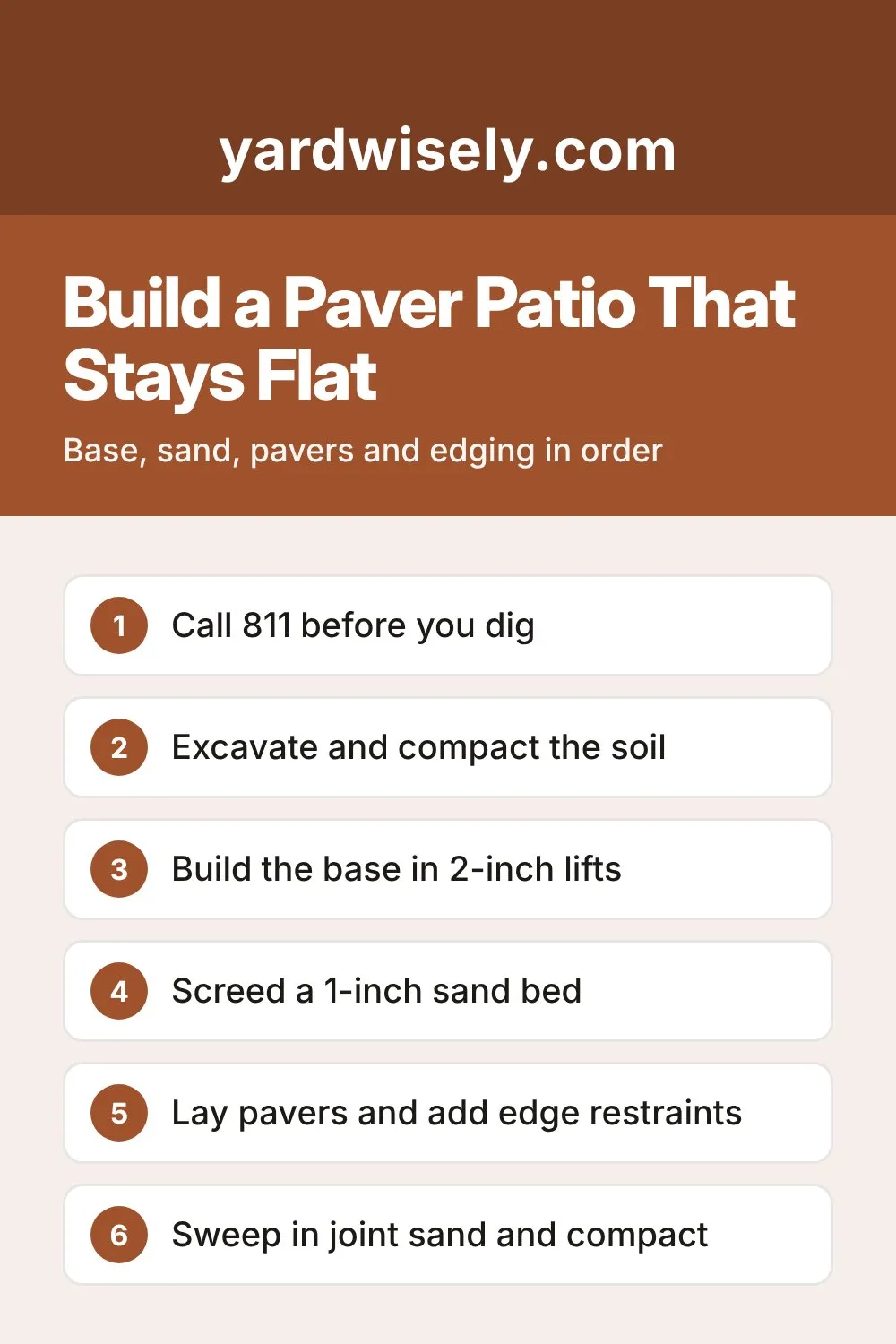
- Add the base in lifts. Spread crushed stone in layers of about 2 inches and compact each one. Repeat until you reach 4 to 6 inches of compacted base. One calculator adds about 20 percent to the planned depth when ordering stone, to allow for compaction.
- Check the slope. Confirm with a level and string that the base falls away from the house at roughly 1/8 inch per foot, as one guide gives. Fix low or high spots now, not after the pavers go down.
- Spread and screed the sand. Lay bedding sand about 1 inch thick (sources often estimate 2 inches because sand settles into the base and joints). Drag a screed board across rails so the bed is smooth and sloped. Avoid stepping on it afterward.
- Lay the pavers. Start from a straight edge or corner, set each paver straight down onto the sand, and keep joints even. Do not slide them, which disturbs the bed.
- Cut the edge pieces. Mark and cut pavers to fit the perimeter with a wet saw or splitter. Wear eye, ear and dust protection.
- Install edge restraints. Fit restraints around the whole perimeter and secure them so pavers cannot creep outward.
- Fill the joints. Sweep joint sand across the surface until the gaps are full, then run the plate compactor over the pavers (with a protective pad if the maker advises one) and sweep again.
Planning tips that save rework
- Size the patio to the furniture. Lay out a table, chairs and walking room with string or chalk before you commit to dimensions, since changing size after excavation means extra digging and base material.
- Order materials with a margin. Pavers need extra for cuts and breakage, and base stone compacts down, so order a little more than the flat-volume math suggests.
- Work in dry weather. A wet, muddy subgrade is hard to compact and a soaked sand bed will not screed cleanly. If rain is forecast, cover the sand and stacked pavers.
- Keep the sand bed untouched. Work from the laid pavers outward and use a board to spread your weight when kneeling, so you never dent the screeded sand.
- Test the layout first. Dry-lay a few rows without sand to check the pattern and where cuts will fall, then start for real from the straightest edge.
- Check the final surface often. Lay a straightedge over the pavers every few rows and tap down any that sit high with the mallet before the joints are filled.
Common mistakes
| Mistake | What goes wrong | Fix |
|---|---|---|
| Thin or uncompacted base | Sinking and dips | Build the base in lifts and compact each |
| No edge restraint | Pavers spread and gaps open | Restrain the full perimeter |
| Play sand for the bed | Poor stability and drainage | Use coarse bedding sand |
| Flat surface | Water pools and stains | Slope away from the house |
| Digging without locating utilities | Hitting buried lines | Call 811 first |
When to call a professional
Hire a pro if the patio needs a retaining wall or major grade change, sits close to a foundation with drainage problems, will carry vehicles, or needs a permit you are unsure how to obtain. A local installer can also advise on soil and frost conditions in your area.
Sources
 Save
Frequently asked questions
How deep should the base be for a paver patio?
Sources commonly give 4 to 6 inches of compacted crushed stone for a patio, topped with about 1 to 2 inches of sand. Add the paver thickness to work out how deep to dig.
Do I need edge restraints on a paver patio?
Yes. Edge restraints around the perimeter keep the pavers from spreading, and leaving them out is a commonly listed cause of failure.
Can I use play sand for the bedding layer?
Avoid it. One installation guide recommends coarse sand for the bed and warns against play sand or fine sand.
Do I need a permit for a paver patio?
It depends where you live. Check local building codes and any homeowners association rules before you start, since some areas require a permit.